

 Share the love —
It’s been three weeks since Lebanon was dragged into yet another war (not that the previous one ever really stopped). Three weeks that feel like a lifetime, and I know I’m not the only one.
Conflicts bring a host of temporal distortions, creating the sense of living in a warped timeline. Several theories help explain this phenomenon.
The Wait
Anthropologists have long been studying wars through a temporal lens, which they describe as long periods of waiting interrupted by short bursts of chaos: the next strike, knowing when to leave, anxiously expecting news from a family member. The act of “waiting” becomes a political condition in conflict zones: time stops belonging to us and becomes controlled by external forces.
As a result, days feel endless and weeks blur together. War becomes stalled time, a sort of limbo we try to navigate. We cling to our phones and watches, almost suspecting them of lying about how many hours have passed since breakfast.
Sleepless nights and long days of uncertainty definitely don’t help. In wartime, who hasn’t found themselves asking their friends which day it is a bit too many times in a week? “It’s Friday,” one of them replied with confidence the other day, after my
disoriented brain wasn’t able to remember. It was Wednesday.
The Two Clocks of War
Of course, other variables add to this unwelcome jet lag. Writers, philosophers, and anthropologists like Veena Das have long written about the coexistence of prolonged violence and ordinary life, and how the latter continues on the margins of destruction.
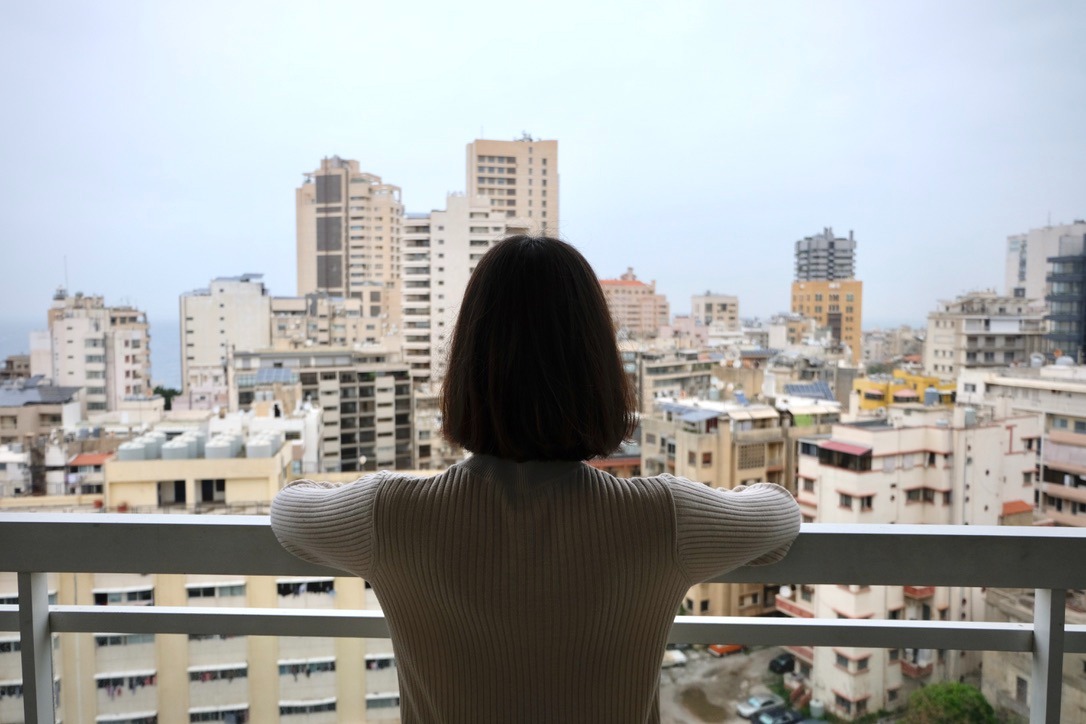
Children playing under the buzzing of drones. Music playing in a café with Israeli fighter jets in the background. People having coffee on their balconies while bombings occur just a few streets away. Examples like these are numerous and have long been used to characterize how wartime feels in Lebanon.
Time seems fragmented every time traumatic events puncture ordinary routines, embedding themselves into everyday life. And soon enough, we’re preparing dinner with the sound of bombings in the background. That, of course, is for the luckiest of us—those who haven’t been displaced or had their homes destroyed and can still experience a sense of normality.
Nonetheless, the repetitive coexistence of these moments creates a psychological state often referred to as “dual reality.” People experience two temporal worlds simultaneously: everyday time and wartime. And it is perhaps one of the most disorienting parts of conflict—one the brain often struggles to process, for it is wired to either feel peace or chaos, safety or fear, but definitely not both at the same time.
War Makes Time Elastic yet Freezes It
Psychologists studying trauma and crisis have also demonstrated how stress stretches time. During danger, seconds feel like minutes, and our senses sharpen. Time seems to slow down as the survival mode we enter pushes us to grasp every moment in an attempt to better protect ourselves.
Researchers studying combat veterans and civilians under bombardment often link this to hyperactivation of the brain’s threat system. Afterwards, this hyper-vigilance mode fades, hours disappear, and days blur together. Again. But war is never just about destruction.
More than ever, it is also a battle over who controls time and speed, and this inevitably reshapes how we experience time itself. French philosopher Paul
Virilio developed the theory of “dromology,” the study of speed, arguing that modern technology fundamentally transforms war, perception, and temporality.
In this context, technology creates a constant state of anticipation, particularly when it is used to make decisions or circulate information. We see this with evacuation alerts and announced targeted strikes taking over our social media feeds on a daily basis.
Time then becomes dominated by expectation rather than events, distorting our perception and creating a kind of temporal acceleration specific to modern warfare. With time being both frozen and accelerating, days feel endless, yet weeks pass before we realize everything has changed. And that dinner you were preparing for your friends three weeks ago, just a few hours before the war started, now feels like another lifetime.
War Also Rewrites Collective Time
On a collective level, time during a war shifts from slow institutional time to urgent decision time. Normal laws are suspended, decisions happen faster, extraordinary actions become normal, everything becomes immediate. The temporal markers on which society is normally organized are removed.
Philosopher Hannah Arendt wrote that violence and total war often destroy the space where political life and planning for the future happen. When war dominates life, the horizon of the future collapses, and people live day-to-day, which leads to the disappearance of long-term thinking. The shift from planning life over the next few months to surviving the next 24 hours reshuffles the cards of spatiotemporal awareness. And soon enough, an entire population lives in suspended time.
As a result, conflicts tend to reorganize how societies remember time, as national timelines are being rewritten. Some historians call it “before/after time,” referring to how a single event suddenly divides life into two eras: before and after the war, before and after a major bombardment.
Such violent events become temporal landmarks for entire generations, shaping how people remember and define their lives. Memories are framed by what happened before or after these events, rather than by one’s age at the time, as is usually the case in peaceful societies.
Added to that is how war fractures historical time. For philosopher Walter Benjamin, revolutions and wars “blast open the continuum of history.” In other words, they make people suddenly aware that history and the status quo can break.
And that is perhaps one of the most unsettling aspects of war in Lebanon: how even a faint sense of stability or security can be shattered in a matter of seconds that stretch into what feels like an eternity, at least for those who still have the fragile privilege of experiencing it.