

 Share the love —
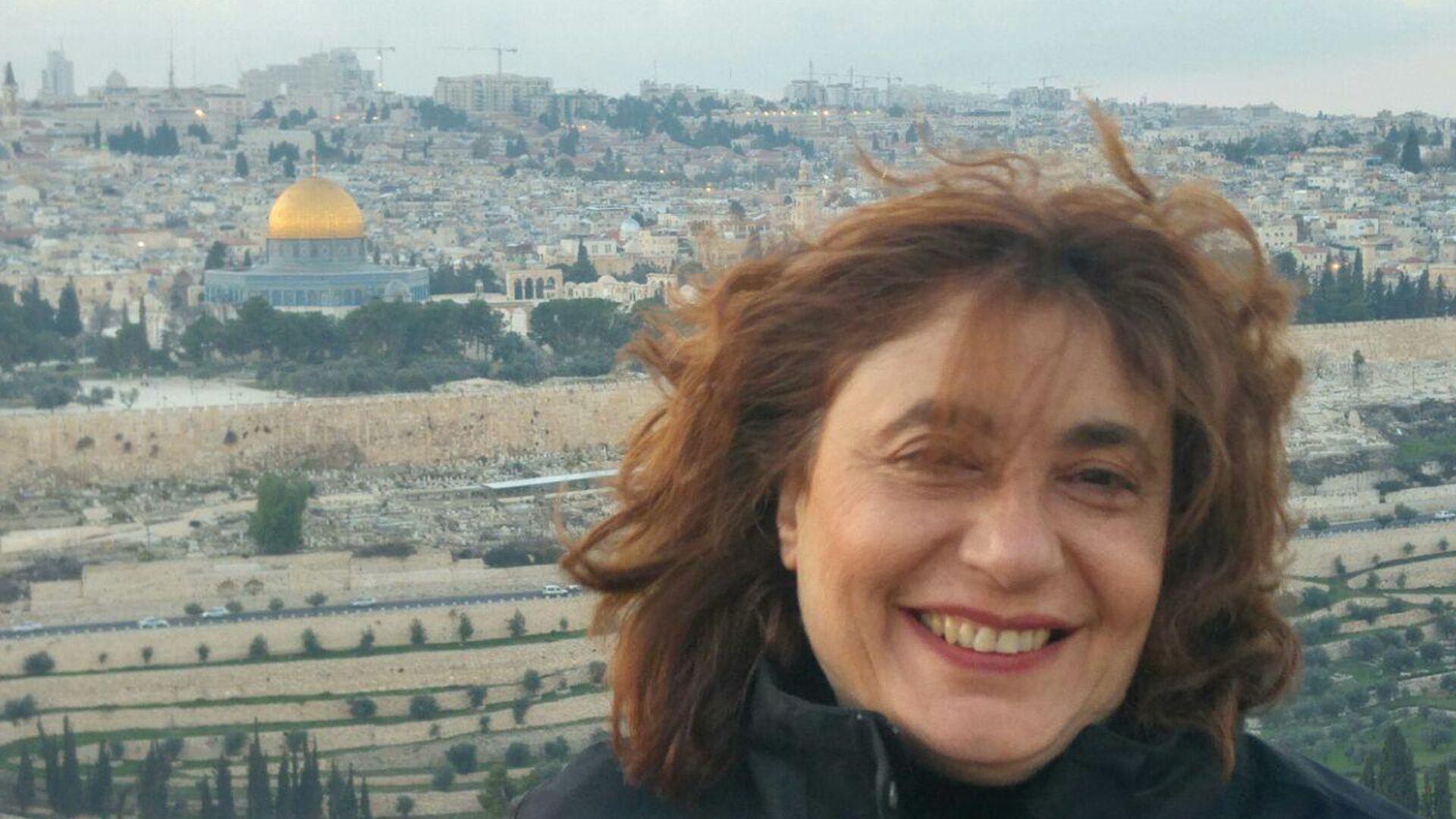
When Siria Yaser finally set foot on the land where her father was born, she felt she was reclaiming what belonged to her.
She had once promised him she wouldn’t go. The Israeli authorities had made it clear that neither he nor his family was welcome.
But in 2018, more than two decades after his death, she decided to go. Not through Ben Gurion Airport, even though, as an Argentine citizen, she could have. She chose the Allenby Bridge, the crossing most Palestinians use. She wanted to enter the way they enter. After all, she was one of them.
—
In the early 1950s, Hanna Yaser – or Juan Yaser as he would later be known across Latin America – had fled Taybeh, a Christian village some 30 kilometers from Jerusalem. The place where he had once moved freely between hills and neighboring cities was suddenly flooded with soldiers carrying a foreign flag.
Hanna saw with his own eyes the theft of land and the displacement of his people following the creation of the State of Israel. He responded the only way he knew how: by writing. Once a teacher, he became what his daughter calls “a revolutionary poet,” but speaking up came at a price.
“They are looking for you. You need to leave now,” said his brother, a lawyer defending Palestinian prisoners, upon learning that Israeli authorities had issued an arrest warrant and were coming to pick up Hanna.
There was no farewell.
His brother hid him in the trunk of his car, drove him to the Lebanese border, and left him to board the first ship leaving port, bound for the Canary Islands. His plan was to eventually reach the United States and continue his intellectual and political work there, but without money or documents, he was running out of options.
Then a letter and a ship ticket arrived: “Come to Argentina. We will figure out the rest from there.”
It was from Jeries Jalil, a neighbor from Taybeh who had migrated to Córdoba, Argentina, decades earlier, becoming part of a growing Arab diaspora across Latin America. Hanna’s brother had written to him asking for help.
Hanna boarded the ship and crossed the Atlantic. He arrived in Buenos Aires on July 9, 1952, only to find the vessel placed under quarantine due to an infection onboard. No one was allowed to disembark. Officials warned that the ship might be redirected to Brazil.
At dawn, Hanna slipped off the vessel, took a taxi to the address Jalil had left for him, and by the next day was on a train to Córdoba.
He spent his first weeks in Argentina hidden in an attic, waiting for Jalil to secure provisional residency papers. He never made it to the United States – love got in the way. Hanna met Nora, Jeries Jalil’s daughter. Two years later, they were married.
Siria recounts details that could only come from someone who has heard the same story many times. Her father made sure both of his children knew about the politics, history, and geography of Palestine. He didn’t do the same when it came to his feelings. Siria remembers the sadness in her father’s eyes. He carried his pain quietly. The pain of leaving without saying goodbye, of learning about his mother’s death from afar, of receiving news of each sibling’s passing while unable to return.
“He made an effort to be present, to smile. He had a sharp sense of humor that made us laugh, but that genuine joy you see in other people, that full-bodied laughter was never really in him,” she reflects.
Hanna Yaser was not just another immigrant. All diasporas carry the loss of departure, adaptation, and longing for what was left behind. But for some, leaving was not optional and returning feels impossible. Palestinians are bound by permits, militarized borders, and policies of occupation. What does “home” mean for someone tied to a land like that?
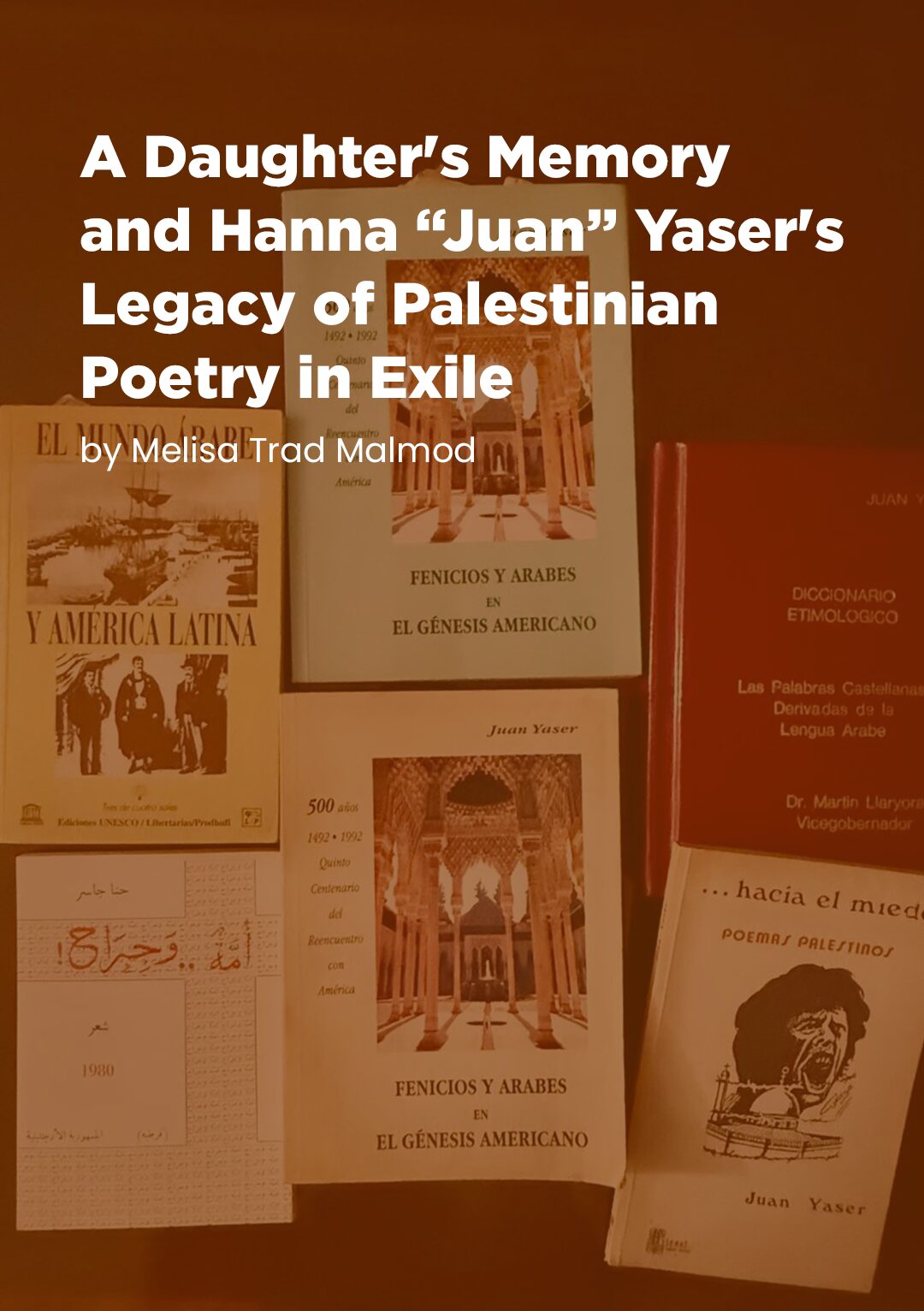
Hanna Yaser felt personally responsible for challenging how his people were portrayed, for correcting what he saw as historical injustice. His life purpose was clear. From exile, he began to write, speak, and organize. He wrote in Spanish so that the new world he had arrived in could understand what was happening. He published books on the history of the “tragedy of Palestine,” collections of poetry, and even compiled a dictionary tracing the Arabic roots of Spanish words.
Over time, Juan Yaser emerged as one of the most prominent Arab cultural voices in Latin America, a reference for understanding the history, literature, and political struggle of his people. So much so that he ended advising Argentine politicians on relations with the Arab world and helped other Arab immigrants arriving in the region, just as he had once been helped.
He missed Palestine, but he knew he had to be outside it for his voice to be heard. He managed to return only one time in his life. It was 1977, and during the month he spent there, he was constantly followed by an Israeli soldier. He still met people. He still gave speeches. When leaving, authorities detained him for six hours at the airport. “This time we’ll let it pass,” they told him. They didn’t want a diplomatic problem with Argentina. “Next time, you won’t leave.”
Two years later, Hanna suffered his first major heart attack. From then on, heart disease marked the rest of his life. His daughter believes the emotional toll of occupation, exile, and the burden of defending his people’s story on his own settled in his body.
“All that pain slowly clogged each of his coronary arteries until it destroyed him. It was too much to carry,” she says.
And still, she reflects, the sorrow felt older than him, almost ancestral. He had been born under Ottoman rule, and foreign domination marked every chapter of his journey. “That is the life we were given. Our family cannot escape this,” she tells me. “We grew up knowing exactly where we came from, what had happened to our people. We grew up knowing the injustice.”
To take ownership of that history became a mandate. “We learned that this was ours to carry. And I still can’t separate myself from that.”
Siria and her brother, like many in the Palestinian diaspora, inherited a grief that began before they were born, tied to a land they cannot walk freely.
Their father tried to shield them from the daily weight of occupation and taught them to love the country where they were born, Argentina. He was not the only one to believe the next generation deserved some distance: uncles sent their children abroad to study; cousins built lives in the United States, Guatemala, and the United Arab Emirates.
From her father’s side, no one lives today in Taybeh. Some relatives on her mother’s side chose differently. They returned, raised their children there, determined to keep a presence in the village so it wouldn’t disappear.
There are no guarantees it won’t.
Today, the streets of Taybeh, the last entirely Christian town in the West Bank, are nearly empty. Since October 2023, attacks by Israeli settlers have intensified: They have burned olive groves, set cars on fire, and even torched the area surrounding the ruins of a fifth-century church. Around 15 families have left since then, part of a steady decline that has reduced the town by hundreds. Residents describe near-daily intimidation, restricted access to farmland, and the constant question of how long they can stay.
Siria follows the news from an ocean away. In 2025, when settlers reached the entrance of Taybeh and burned fields and cars, she called her cousins in panic. They told her not to worry, that this, too, would pass in a few days. “They live like that,” she says.
She dreams of visiting more often, of seeing the land her father owned – land she doesn’t know whether she could now identify or if it is occupied.
For now, what she can do is keep his memory alive.
Her father died when she was 30. She is 60 now and has lived half her life without him, but he left her books, stories, and a way of standing in the world.
His library still occupies space in her home in Córdoba. Some of the books he wrote are displayed in exhibitions, and she plans to digitize them before they disappear. She once tried to send the Arabic volumes to Taybeh but was blocked by Israeli restrictions.
Siria got emotional when she received an invitation from the Arab Culture Club in Argentina to a gathering marking 100 years since Hanna Yaser’s birth. The city where he rebuilt his life after exile became a bridge back to the homeland he never stopped writing about.
Honoring him is about continuing his legacy “not because of who he was, but because of what he wanted the world to know,” she says. In doing so, she is not only remembering Hanna Yaser, she is making sure Palestinian voices and their history are not silenced.
Working in the judiciary, she has spent decades cultivating neutrality. For years, that meant keeping her views about Palestine largely private out of respect for her institutional role.
But since the genocide in Gaza began, that balance has shifted.
“These two years have changed all of us,” she says. Even as a faraway witness, the weight of what is happening makes ordinary joy feel almost inappropriate. “What we feel is nothing, a crumb compared to what people there are living.” And yet the pain is real, and it has pushed her to act.
Now nearing retirement, she wants to dedicate more time to advocacy. Social media became the space where she could speak. At the same time, she has turned to studying and writing about the history of Palestine from its earliest civilizations to the present, responding to what she sees as a growing wave of historical denial.
She often thinks about what her father would have done in this moment. Many have told her how much he is missed now. His poems, written decades ago, feel current.
“Saladin bites his grave!
And the flowers of my land have sworn not to grow!
(…)
Oh… dissonant symphony in the ears of the powerful!
Your echo will resound among the free
of future generations,
when the Land of Resurrection
outlives the Empires!”
Siria’s phone wallpaper is a photo she took of the door of her father’s childhood home in Taybeh. It was taken during the same trip in which she watched her own daughter go through checkpoints and get interrogated by Israeli officials.
She knows her pain will also be her daughter’s, but Siria and her father are a testament to the fact that grief can transform.
Exile doesn’t end with those who depart. In many diasporas, it is women who become the custodians of memory: the ones who keep the pictures and the recipes, remember the names, retell the stories, teach children how to pronounce the villages correctly. It is also a form of care, the kind of unrecognized emotional labor that allows history to survive in the first place.
And, for Palestinians in the diaspora, memory itself is a form of resistance.