

 Share the love —
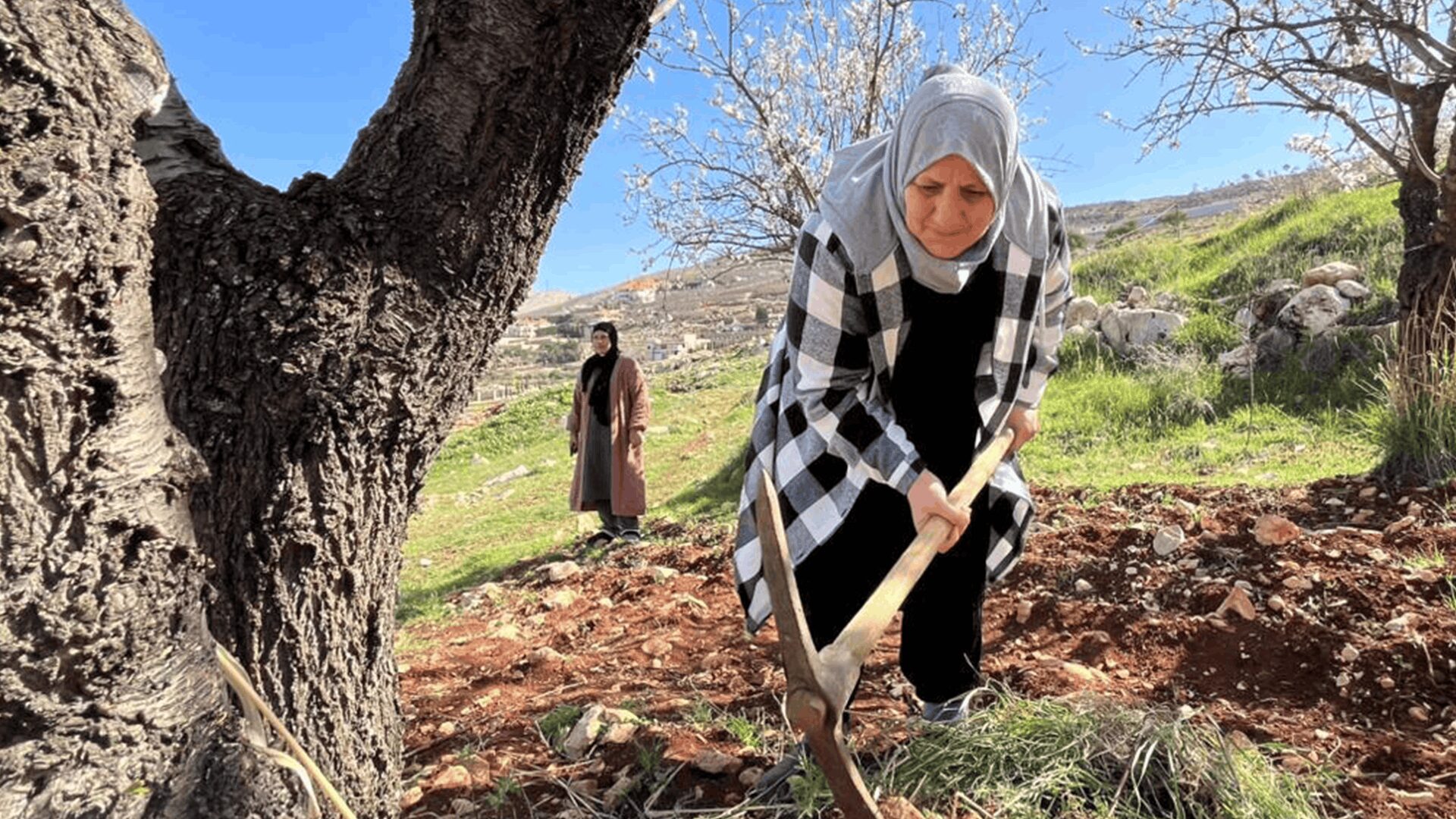
It’s 4:00 am. The sun hasn’t yet risen, but 58-year-old Souad Zaitoun is already harvesting the fields. It is all she’s known her entire life.
Growing up in Al-Sawiri, a small village in Lebanon’s Bekaa Valley, she didn’t attend school, working in the fields instead of learning to read and write. At 13, she was sent off to wed. At 24, her husband passed away, leaving her land to cultivate on her own.
For three decades, she has woken up before dawn to work. It was the only way to avoid the scorching heat and provide for her five orphaned children.
Souad takes me to her modest land, where green waves of wheat sway in the February wind. The wheat has barely grown a few inches, as harvest season hasn’t begun. She recalls with sadness how little she harvested last year. “I planted 15 dunams (about 15,000 m²) of wheat, but only yielded three sacks,” she says.
This has been her reality for the past three years because of declining rainfall. “Without water, I have nothing,” she says. In winter, agricultural work stops and she relies on her siblings abroad, who send her $50 per month to cover her expenses. In summer, she spends around $500 per season on water, as her crops need a tank every two days to grow.
She worries about the four women she employs on her land, close friends and relatives with living conditions even tougher than her own. Souad is one of thousands of women in the Bekaa Valley struggling because of water scarcity, a growing problem threatening rural livelihoods.
According to the Food and Agriculture Organization (FAO) and Lebanese authorities, cumulative rainfall in Bekaa regions was more than 50 percent below the seasonal average in the 2024-2025 winter season, severely affecting soil moisture and crop production.
Scientists warn that such extreme variations are becoming more common due to climate change. The FAO’s agricultural damage and loss assessment for Lebanon estimated that the agriculture sector suffered hundreds of millions of dollars in losses across crops, livestock, and infrastructure, with the Bekaa among the hardest-hit areas.
In Saadnayel, another Bekaa town, Serge Harfouche has witnessed the changes firsthand. He is the founding member and president of Buzuruna Juzuruna (Our Seeds, Our Roots), an agroecology organization working on local seed preservation, farmer training, and climate resilience.
“Farmers whose livelihoods depend entirely on agriculture are selling or abandoning their land,” he says. “Agricultural land has increasingly been converted into warehouses or urban developments over the past six or seven years.”
Harfouche notes that crop deterioration began two or three years ago, with last summer marking a turning point. A large percentage of daily agricultural laborers in Lebanon are women, predominantly refugees, who are highly vulnerable to drought because they rely on daily wages.
“About 60 percent of workers are women doing harvesting and weeding,” says Harfouche. “If they don’t plant because there’s no water, these women won’t work, and if they don’t work, they won’t eat.”
Women are also active in cooperatives focused on mouneh, the traditional practice of preserving seasonal foods and crops. When yields decline, so do production levels and incomes.
Harfouche sheds light on women’s role in water management, noting that in many rural communities, women often manage household water use and therefore may have detailed knowledge of consumption patterns.
In such circumstances, women like Souad are finding creative solutions. “We reuse water from washing tomatoes or boiling wheat to water our plants,” she explains.
To help farmers withstand drought, Harfouche’s organization promotes agroecological practices rooted in tradition. Central to their work are local heirloom seeds, adapted over generations to survive climatic fluctuations.
“We irrigated only once last spring,” he says, “while neighboring farmers watered six or seven times. Yet our fields produced significantly higher yields.”
For Harfouche, the lesson is clear. Resilience begins with seeds that can reproduce and adapt, reducing dependence on costly inputs. His group also encourages mulching to reduce evaporation, planting into straw to suppress weeds, and replacing chemical fertilizers with compost.
Dr. Majida Mcheik, head of the Program Department at the Lebanese Ministry of Agriculture, says the ministry is working to support women-led agricultural cooperatives. Some development projects funded through international loans include components dedicated to supporting these groups.
In early 2025, when rainfall shortages became clear, the ministry issued guidance to farmers and formed the National Committee for the Regulation and Rationalization of Agricultural Irrigation Water.
“The major problem farmers face is outdated irrigation canals,” explains Mcheik. “Many are unlined, damaged, or uncovered, leading to significant water loss through leakage and evaporation. Part of the water is simply lost before it even reaches the farmer.”
According to Mcheik, around 50 percent of farmers still rely on traditional flood irrigation instead of modern drip or sprinkler systems, which are too expensive for smallholders.
“The transition to modern irrigation requires upfront investment, and farmers must pay in cash,” she says. “Installment options used to be available, but not anymore.”
With limited resources, the ministry is focusing on water harvesting strategies, including reservoirs and agricultural ponds to collect rainwater. Plans are also underway to expand treated wastewater use for irrigation.
Across the Bekaa, women like Souad are adapting to this growing crisis, sustaining entire farming systems with limited resources and invisible labor. Their knowledge, passed down through generations, is central to climate adaptation.
“When you work the land, you feel happy,” says Souad. But happiness does not pay for water tanks, nor does it guarantee next year’s rain.
Souad will plant again this year, even if the rains fail. Before sunrise tomorrow, she will return to her fields, hoping the soil still remembers how to give.