

 Share the love —
Growing up Moroccan in New York City, I was never surrounded by Moroccans in the way many members of the diaspora in Europe are. I often felt caught between worlds—Moroccan at home, American everywhere else. I didn’t grow up on Steinway Street in Astoria either, where many Arab and North African families found community. I was born in Harlem and moved throughout the city—to the Bronx, Manhattan, Brooklyn—before settling down as a teenager. Wherever I went, I rarely met other Moroccans my age. For a long time, Morocco felt like something I inherited rather than somewhere I belonged to.
Then the 2022 World Cup happened.
At the time, the only Darija I knew was “shukran” (thank you) and “la shukran” (no thank you). That’s it.
The match against Portugal remains one of the clearest memories of my life.
It was December 10, 2022. The quarter-final. Morocco had never been this far before.
My grandmother made Moroccan mint tea before the match, hoping it would calm our nerves. I can say it was the first time in my life it was left cold. My father pulled out all of his Morocco gear—from flags to his derbouka.
The three of us sat on the Moroccan sedaris that line our living room, covered in the same fabrics they had when I was a kid. Nobody moved.
Then, in the 42nd minute, Youssef En-Nesyri scored.
It was the first time I had ever seen my father leap for joy.
I flashed my shitty $20 camera at my family to preserve the moment. My dad, grandma, and I hugged. My father looked at me and said, “3taha boussa”—give your grandma a kiss—with tears in his eyes. For a second, I saw the young Moroccan boy he once was, kicking a football through the streets of Derb Sultan with a dream of one day going pro.
For a second, it felt like the entire world had stopped inside our living room.
The next day, I was sitting in my university’s acting class when a message from my dad popped up:
“Do you want to fly to Morocco tomorrow to watch the rest of the games?”
Immediately, I said yes.
That trip changed my life.
It connected me to my country in a way I had never felt before. It started my journey to learn Darija so I could properly communicate with my family. I learned how to cook Moroccan dishes. I started listening to North African music. I became proud of my country in a way I never had before.
Proud of my ancestry. Proud of my roots. Proud of my nose.
Now, with the World Cup coming to the United States—the country I grew up in, over 3,000 miles away from Morocco—I’m experiencing another first.
For the first time in my life, I’m seeing this many Moroccans in New York City—the city my father immigrated to, achieved his dreams in, and raised my sister and me in.
Growing up Moroccan in New York, you feel at home everywhere and nowhere all at once. It’s a city that forces you to choose a version of yourself from the moment you’re born. And when you don’t see your ethnicity reflected around you, you start to wonder where exactly you’re supposed to belong.
That’s why this World Cup means so much more to me than football.
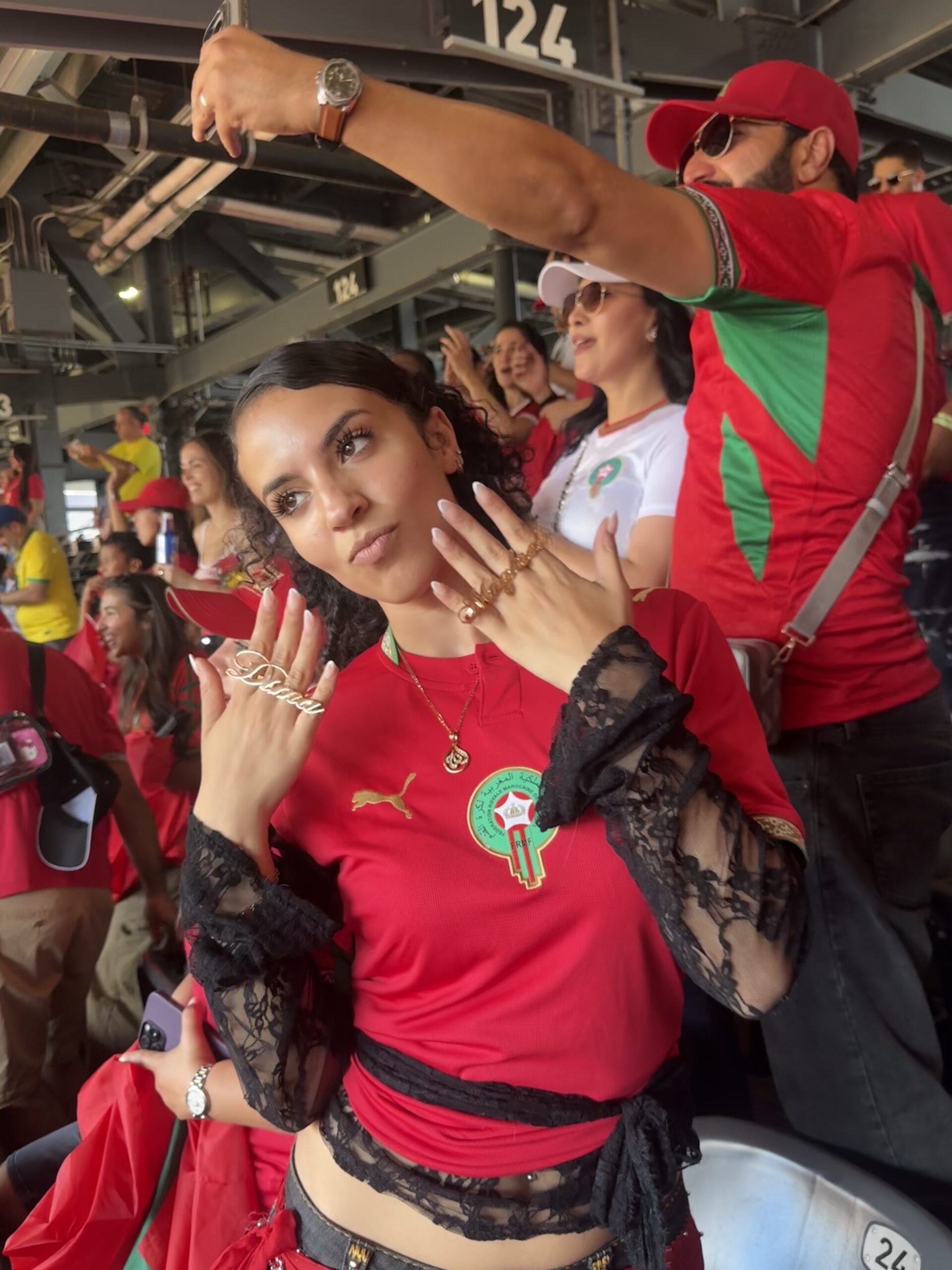
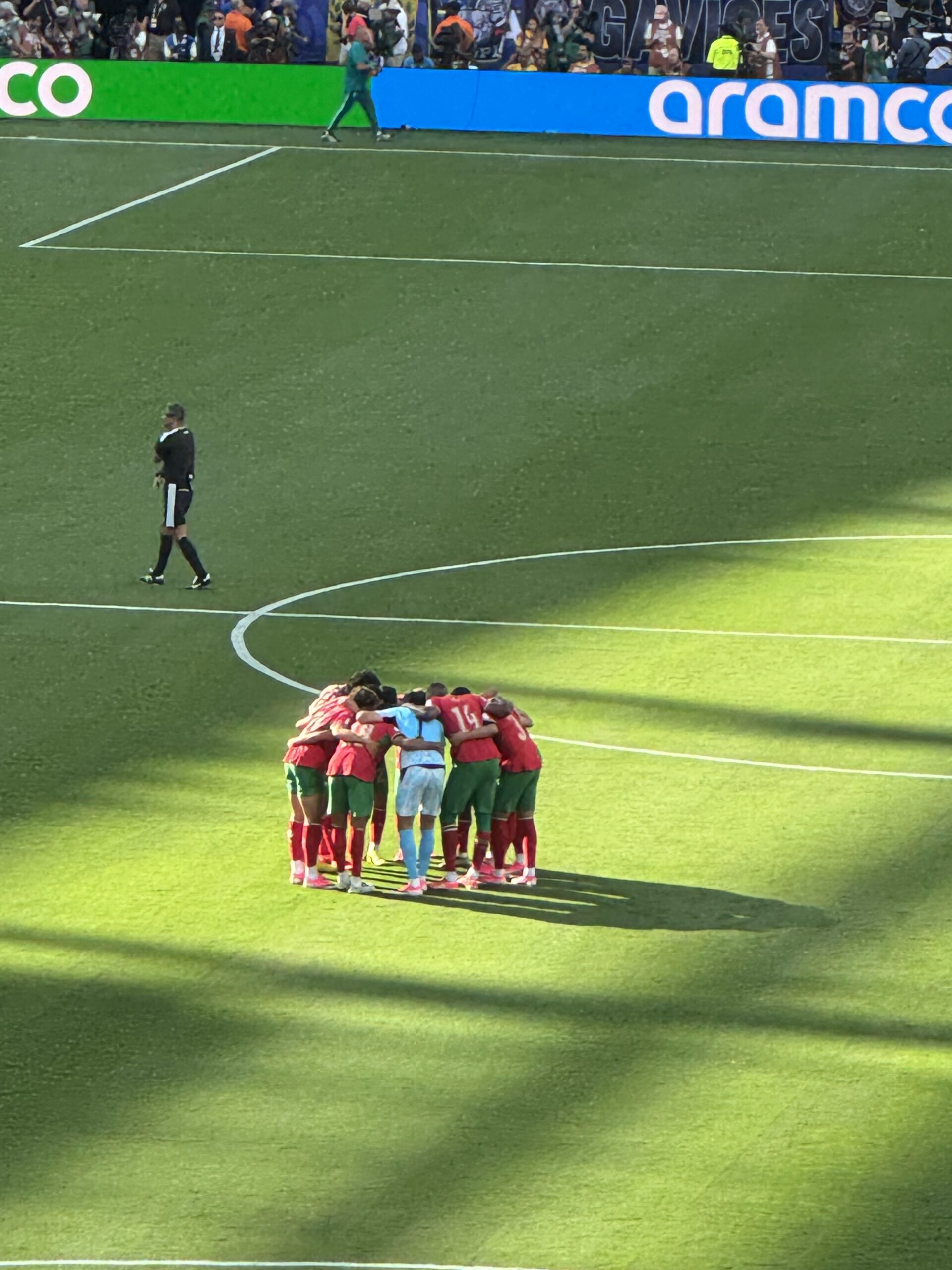
I recently went to the Morocco-Brazil match with my dad, uncle, and cousin. It was chaos in the best way. Brazilians everywhere. Red and yellow split across food courts and parking lots. People singing, doing zaghrouta, arguing, celebrating.
And I remember thinking how grateful I was just to witness it.
Because growing up, I never imagined I’d see this many Moroccans gathering publicly in the city I call home.
Ultimately, the hope I have for this World Cup is simple.
Of course, I want Morocco to make another historic run. Of course, I think we have the talent, confidence, and skill to do it. The last World Cup proved it to everyone else. We already knew it.
But beyond results, I hope this tournament leaves something bigger behind.
I hope young Moroccan and North African kids growing up in places like New York see themselves reflected in the crowds, the flags, and the celebrations. I hope they realize their dreams can become reality, and that they grow up knowing they don’t have to choose between being American and being North African.
I hope they feel pride in where they come from before it takes a miracle World Cup run to unlock it.
And I hope America begins to make more space for North African stories, especially for women like me. Growing up, I rarely saw us represented, which is why I create space in my films, designs, and content. I hope I can help create that space for the next generation, too.
Football ultimately gave me something I didn’t know I was missing: a deep connection to my family, my culture, and my country. What began as ninety minutes on a television screen became a bridge back to my identity.
Four years ago, I got on a plane to discover Morocco.
Today, I can see it all around me.
For the first time, it feels like home.
Dima Maghreb.