

 Share the love —
They say a girl’s father is the first love of her life.
In my case, this was in fact true.
My father raised me without my mother. He has always been the fixed point, the person against whom I measured safety, the first man whose opinion mattered more than my own. As a child, I was unequivocally a daddy’s girl, and I held him in omniscience, which is to say, completely and without question.
My mother’s absence deepened it. I resented her for leaving, and that resentment pushed me further into my father’s arms and his worldview.
What I loved, and still love, about him is his consistency. For all his faults, my father has remained. He has several children by multiple women, and he has provided for every one of us. That is not a small thing. I need to say that before I say anything else, because the complexity of him gets flattened if I don’t. He chose his children, without condition, without fail, and that kind of choosing is something I have yet to encounter in any man I’ve met romantically.
That is, truthfully, one of the things that makes all of this so difficult to write.
But children grow up, and when they do, they begin to see their loved ones as people. I was 18 when I left home to study English Literature at university. It was there, in the pages of books, that I encountered feminist theory and the kind of language that permitted me to name things I had seen but couldn’t articulate. I read about men who loved inadequately; who promised women one thing and gave them something else entirely; who moved through relationships, leaving behind damage they never paused to account for.
Somewhere in the accumulation, I began to recognise something. Not a villain per se, but someone familiar: my father.
My father does not believe in monogamy, though he has never knowingly been in a polygamous relationship. My stepmother, the woman he is with now, is the same woman he was involved with when he was still with my mother. He has told me, more than once and without apparent contradiction, that my mother is his first and truest love. I have turned that over in my mind more times than I can count. The strange, painful weight of that confession, what it must cost my stepmother to live inside it, what it cost my mother to be loved first and still lose.
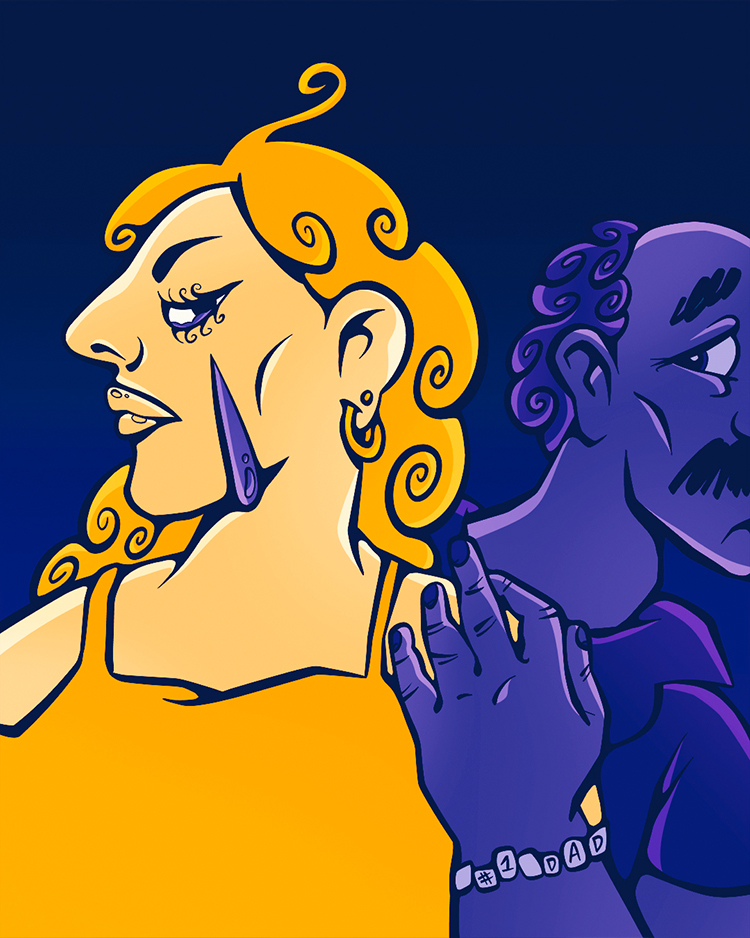
My father is not a cruel man, but I think that is almost the point. He is, at his core, a boy who never learned how to treat a woman. Who was then, in what I describe as one of God’s pointed jokes, blessed with five daughters who one day might experience men as women have experienced him.
The dissonance of loving my father while watching what he has done to the women in his life is something I’ve spent years trying to reconcile. It is not as clean as anger, and though I have felt that too, it is something closer to grief. The grief of loving a person fully, then slowly understanding that the version of them you loved as a child was always partial, that the fuller picture asks more of you as an adult woman than you’re willing to give.
I have told him, more than once, that I love him, but could never marry a man like him. The first time I said it, he was surprisingly hurt. I do not think he had ever considered that his behaviour toward women might reach as far as his relationship with his daughter. To him, there are worse things a man can be than unfaithful, and I have always agreed with that. Men have, unfortunately, caused irreparable damage to the lives of women and girls in ways that go far beyond infidelity. However, agreement and acceptance are not the same thing.
What I cannot yet tell him, because I do not have the words for it, is the unspoken way his example has shaped how I move through my own experiences of love and loss. When I had my first heartbreak, I could not go to him. Not because I didn’t want to, but because I genuinely did not know which version of him I would find: The father who would sit with my pain and mean it, or the man who hadn’t always shown understanding and accountability for the feelings of a woman who trusted him.
That uncertainty is its own kind of inheritance. My older sister, who is also my mother’s child and who grew up watching the same man, shared that being raised alongside our father had done something to her nervous system. That she sometimes found herself unable to fully trust the things her husband said. Not because of anything her husband had actually done, but because our father had unintentionally taught her that the men who love you are not always men you can trust.
When it comes to my own romantic life, I have intentionally sought out men who are unlike my father. I am a woman who understands the emotional, mental and physical cost of tying your destiny to a man, and though I have encountered some horrible partners in my life, I believe in leaving. My father thinks this makes me sensitive and unrealistic, but I don’t believe in suffering for love.
I want to be fair to him, because fairness feels like the only honest way to write about someone you love. My father is a good father, in every way that involves presence, provision and choosing his children above all else. I have never doubted that he loves me. Still, I have learned, as I have gotten older, to hold two things at once: that a man can be devoted to his daughters and careless with his partners, that these truths do not cancel each other out, that the version of him I grew up worshipping was real, and also incomplete.
I am not writing this in the hope that he will change. I have loved him long enough to understand that some people simply will not, even when they are the first person you ever loved, even when you have told them plainly what their choices have cost the people around them. What I am writing toward is something else entirely: It is the acceptance of him as he actually is, a good father, a complicated man, a boy who never learned how to love a woman the way she deserved, and who has spent his whole life circling that gap without ever fully naming it.
He was the first man I ever loved, and in more ways than he will ever know, he is still teaching me. One of the many lessons being that loving someone is not the same as liking them as a person.
Though I love my father deeply, he is not a man I will ever truly like.
 romantic relationships">