

 Share the love —
“I want to go to the hospital.”
For a long time, I did not know how to interpret this sentence when it appeared in my mind, quietly, almost shamefully, in the middle of ordinary days. It never came during moments of crisis, never after a dramatic incident. It arrived instead while staring at a messy house I had already cleaned four times that day, while changing diapers, washing hands and faces, feeding the older child, nursing the younger one, dressing one, changing the other, negotiating bedtime, practicing patience, swallowing irritation.
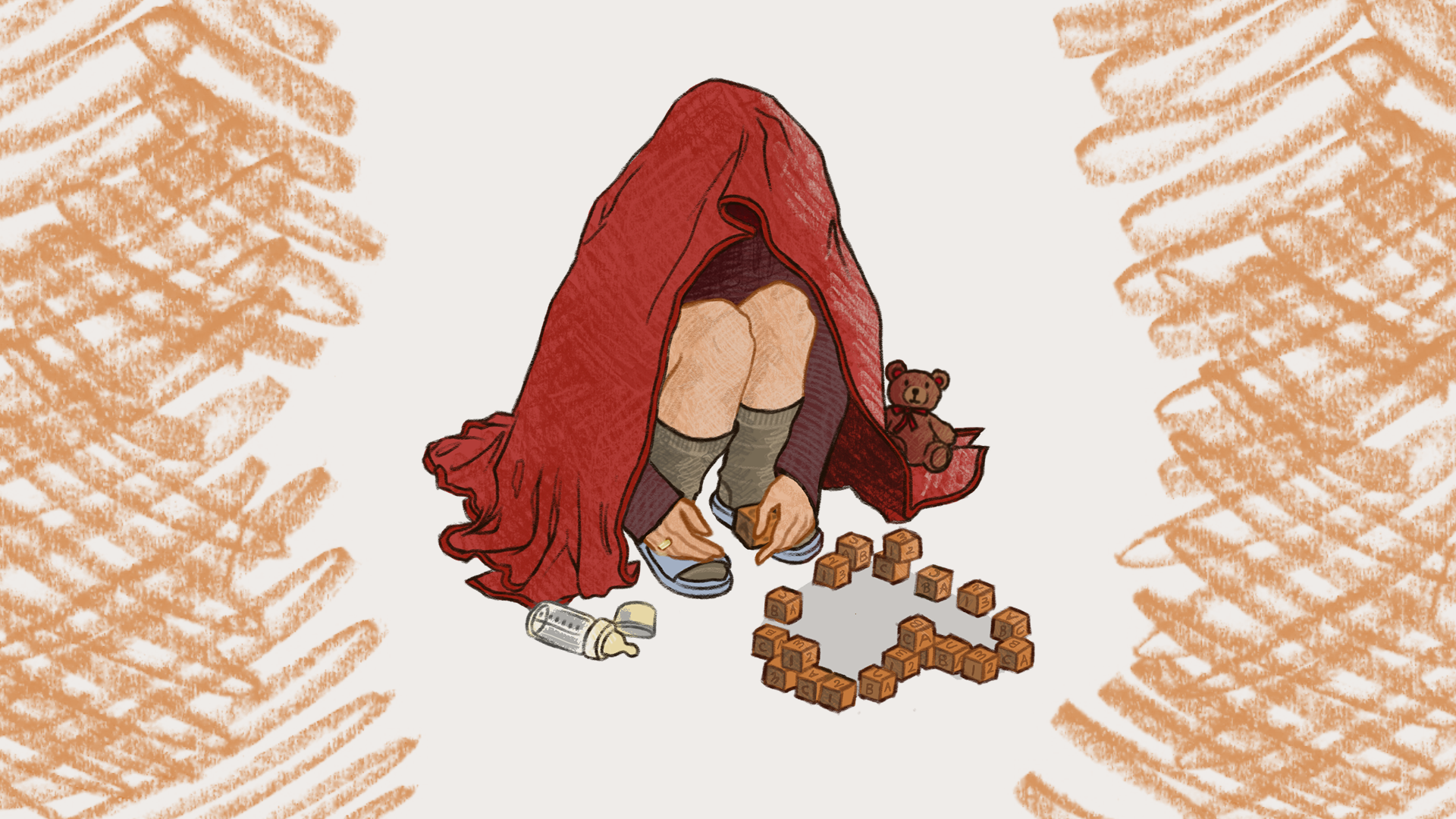
“I want to go to the hospital.” I was neither ill nor injured. I was exhausted in a way that had no language. What I was longing for wasn’t medical care; it was permission. Permission to temporarily leave and lie down, without carrying that ancient and internalized guilt that rarely leaves.
At the time, I thought this desire was strange, perhaps even the beginning of a serious mental health problem. What kind of person secretly wishes to be hospitalized? I filed the thought away, alongside many others, under the category of things that should not be said.
Years later, through Omoubou, the Tunisian storytelling platform I founded to collect and share women’s experiences of motherhood, conversations began to emerge around a simple question: What are the things you stopped being able to do after becoming a mother?
The answers came quickly: Sleep. Rest. Time alone. Silence.
One woman wrote that her hospitalization after childbirth had been the only period in her life when she truly rested. Another confessed that she had secretly wished to fall seriously ill, just to escape for a few days. Then another echoed the same forbidden thought.
I continued the conversation in private messages with different members of the Omoubou community and discovered that many of us, at some point, had fantasized about being hospitalized. One mother even told me that she had asked her doctor to prescribe her two nights of rest in a private clinic so she could finally sleep and leave her twins with their father – a man she later divorced, but that is another story.
It was a revelation. What I had taken for personal madness was, in fact, a shared social symptom and it had a name: maternal burnout.
A study conducted during the COVID-19 lockdown in Tunisia offers a stark portrait of this invisible collapse. Over 70 percent of mothers met clinical criteria for maternal burnout, with a significant portion experiencing high or extreme exhaustion. Structural pressures were the strongest predictors: the age and number of children, financial strain, and the near-total absence of leisure or personal time.
Neither the mother’s age, medical or psychiatric history, nor perceived spousal support offered meaningful protection, suggesting that wellbeing cannot rely solely on the household or couple.
More than a third reported moderate to severe anxiety or depression, and burnout was strongly correlated with both, showing how emotional depletion and psychological distress reinforce one another.
Beyond Tunisia, cross-national research confirms that maternal burnout is not exceptional. In a study of over 11,000 mothers across 40 countries, burnout was highest among mothers with egalitarian values living in societies where overall gender equality coexists with persistent inequalities in parenting roles. These findings dismantle the comforting belief that maternal burnout is a personal failure. While these studies hint at the scale of exhaustion, they reveal little of its emotional cost.
Psychological research consistently shows that burnout is more than fatigue. Its core is emotional exhaustion: a gradual erosion of affective resources that weakens empathy, diminishes emotional presence, and strains relationships. Longitudinal studies confirm that as burnout grows, the capacity to perceive and respond to others’ emotional needs declines, not as a moral failing, but as a predictable consequence of sustained affective overload.
Burnout does not only drain energy. It reshapes intimacy. To survive, exhausted individuals develop emotional distancing, numbing, and withdrawal. These strategies protect the self from collapse, but they also reduce the capacity for deep emotional connection.
For mothers, this reveals a painful reality: when emotional and physical resources are depleted, the capacity to love – deeply, attentively, and intentionally – can be diminished, leaving women unable to express the fullness of care and connection they wish to offer.
I have been there myself, and when I look back at my own mother, I begin to understand her emotional distance. We were clean, fed, dressed; the house was orderly – but closeness, connection, presence were rare. She was not cold, she was depleted.
I can already hear the protests: Maternal love is instinctive. It is natural. It is unconditional. All mothers love their children.
This belief circulates so widely that it begins to feel like a law of nature. Families, media, religious teachings, all reiterate the same narrative. It reassures society: If maternal love is automatic, then no one needs to concern themselves with the conditions in which mothers live. Love will take care of everything.
And yet, the testimonies collected through Omoubou quietly dismantle these myths. Women speak of not feeling anything at first sight. Of not being struck by love at birth. Of numbness, fear, disconnection. Of love that arrived slowly, hesitantly, built day by day, learned, negotiated. And always, of guilt – the conviction that they were alone in this experience, defective in a role that society insists should come “naturally.”
I have listened to dozens of women navigating pregnancy, miscarriage, infertility, postpartum depression, migration, unemployment, and isolation. Their stories differ in detail, but converge in structure. What emerges is not a collection of personal failures, but a shared wound. Each mother believes she is personally inadequate, internalizing responsibility for a reality created by structural neglect.
This internalization is patriarchy’s most efficient mechanism. When exhaustion is framed as personal weakness, the social and political dimensions vanish. Structural violence remains invisible, and silence becomes a tool of discipline.
Yet these stories reveal something crucial: love is not absent. It is overextended, strained, and starved of the support it requires.
Love is not automatic; it is constructed. Yet most women enter motherhood without any map of what this construction entails. Maternal love arrives as a stranger: We are told it exists, that it will come, that it will save us, but no one explains its texture, rhythms, conflicts, or fragility.
We are expected to “feel” love, not to practice it. At the same time, the other dominant model of love – romantic love – has long been exposed as myth.
Popular culture promises fusion, passion, permanence, and rescue, yet feminist and psychological critiques reveal these as unrealistic, gendered, and often harmful. As a result, women are left improvising: trying to love without having learned how, trying to care without having been cared for, attempting to give what they themselves never received sustainably. The lie of “natural love” not only exhausts mothers, it disorients them, leaving them without a shared language of care, boundaries, reciprocity, or repair.
As Bell Hooks reminds us, love is “the will to nurture one’s own or another’s spiritual growth, revealed through acts of care, respect, knowing, and assuming responsibility.” Love, in this sense, is not a spontaneous feeling; it is a discipline, a practice, an ethical commitment. It requires time, energy, security, and reciprocity. But what happens to the will when the body is depleted? To commitment when survival consumes all available energy? To generosity when there is no space left for oneself?
Across Tunisia and much of the region, maternal love has been assumed, unacknowledged, and endlessly available. Framed as natural, it becomes invisible and unsupported. The forms of love that sustain societies by shaping emotionally secure adults and resilient communities are confined to the domestic sphere and stripped of political meaning. They are treated as personal virtues rather than collective responsibilities. When devotion is sacralized, it replaces rights.
We are tired, and society calls it strength.
We are overwhelmed, and society calls it devotion.
We are depleted, and society calls it love.
Maternal burnout forces us to rethink love. Love is not instinct. It is labor, attention, patience, and presence. Like any human capacity, it requires conditions to flourish.
Maternal burnout is socially manufactured by the absence of state- or community-supported postnatal and at-home care services, inadequate public childcare and parental support structures, weak or nonexistent parental leave, limited access to mental health care, gendered divisions of domestic and emotional labor, persistent inequalities in household care, and moralized expectations of self-sacrifice.
Every day, love is asked to compensate for failing institutions. The fantasy of hospitalization embodies this truth: it is not a desire for illness, but a desire for legitimacy, a recognition that only breakdown authorizes relief and rest.
Love, stripped of its patriarchal script, becomes what it should have been: a practice of reciprocity and justice. A bond supported by institutions as much as by emotions. A relationship protected by rights as much as by feelings. No woman should have to fantasize about illness to feel allowed to rest. No mother should have to break in order to be held.